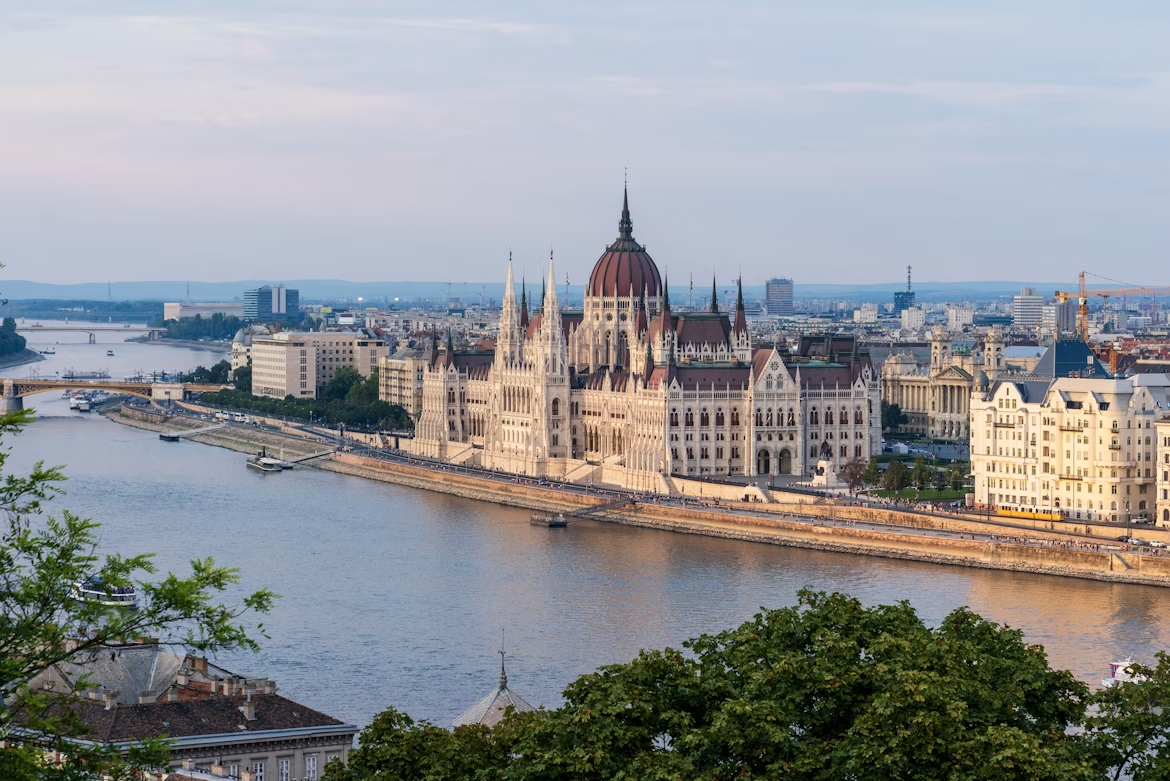
One of my favourite escapes, no matter the season, is Budapest. Just as enchanting in the summer as it is in the depths of winter, the city unfolds gradually, the old and the new intertwining in a way few other cities can match. There is the grandeur of the Parliament building, its crown of spires reflected in the Danube; characterful bridges linking Buda and Pest like elegant handshakes across the water. Yet once the scale has made its impression, it is the intimate details that take hold. The scent of fresh pastry curling from a pékség on Dohány Street, the clink of porcelain in the New York Café where velvet banquettes still swallow you whole, the rising mist as the doors of a neighbourhood bathhouse ease open on a winter’s morning.
The character of Pest
Pest, with its broad avenues and fading façades, wears its Austro-Hungarian past openly. The architecture speaks of confidence and ambition, yet time has softened the edges. Andrássy Avenue leads you past the grand façade of the Hungarian State Opera and into Liszt Ferenc Square, where restaurants spill onto the pavement in summer. At the Great Market Hall near Liberty Bridge, piles of paprika, garlic ropes and slabs of cured mangalica pork fill stalls beneath a soaring iron roof. Yet step away from the boulevards and you find quieter pleasures: an espresso at Café Gerlóczy, tucked away in a Parisian-style square, or a glass of Bull’s Blood from Eger in a candlelit wine cellar on Kazinczy Street.
The quieter rhythm of Buda
Crossing the river brings a shift in mood. Buda rises steeply, its cobbled streets coiling toward the castle district and the Matthias Church. From the Fisherman’s Bastion, the view across the water reveals Pest laid out like a map, the Parliament on one side and the endless plain beyond. Go early in the morning to avoid the coach loads of tourists. Venture a little further uphill and you discover Czakó Kert, a garden café where vines curl across pergolas and plates of fresh strudel are served with coffee under chestnut trees. Buda feels more private, more residential, but these quieter moments are some of the city’s most enduring.
The baths and their rituals
Visiting one of Budapest’s many thermal baths may seem cliché given how popularised they have become, so you may be forgiven for thinking twice about it, but you’d leave the ciy poorer for doing so. Széchenyi is the most photographed, with its lemon-coloured arcades and pools steaming in winter fog, but the smaller, less publicised Király Baths carry a different kind of charm, their stone walls and domes little changed since the 16th century. At Rudas, the octagonal pool glows in the filtered light of a Turkish dome, and in the evenings younger locals gather in the rooftop pool, the city spread out below. To visit any of them is to experience Budapest in its most authentic form, with the unhurried pleasure of water and steam enveloping the soul.
Eating and drinking
Food here is at once hearty and inventive. There is comfort in a deep bowl of gulyás at Fakanál, the restaurant tucked into the Great Market Hall, or decadence at the New York Cafe, where breakfast spots require advance booking. In District VII, the city’s old Jewish quarter, ruin pubs such as Szimpla Kert offer late night beer among peeling walls and mismatched chairs, while nearby the new wave of kitchens reinterpret tradition. At Borkonyha Winekitchen, one of Budapest’s Michelin-starred restaurants, Hungarian wines are paired with dishes that nod to the classics without being bound by the rules.
Evenings by the river
The Hungarian State Opera remains one of Europe’s most beautiful concert halls, and its programme of opera and ballet is as strong as the setting. For chamber music, the Liszt Academy provides a smaller, gilded jewel box, while jazz clubs along Nagymező Street draw late night crowds. Beyond the concert halls, the Danube itself provides the evening’s stage. From the deck of a small riverboat you watch the Chain Bridge and Buda Castle glowing above the water, while the façades of Pest shimmer in reflection. Even on foot, a stroll along the embankment after dark is enough.
Getting there by rail
Travelling to Budapest by rail carries a sense of ceremony that flying cannot match. One of the most scenic routes begins in Munich and winds through the Tyrolean Alps, past Innsbruck and Graz, before turning east into Hungary. The scenery changes in slow succession: alpine valleys, rivers carving through pine forests, lakes glinting in the sunlight, and finally the sweep of the Hungarian plain.
For tailormade rail package holidays that include this journey and all your hotels along the way, head over to Byway (byway.travel), a UK based outfit with a 5 star TrustPilot rating. Please let them know you heard about them through us!
If you’re a little unsure where to start and want the hassle of booking tickets and choosing hotels taken off your hands, they can build you a fully custom one way or return trip starting almost anywhere, and you also get on demand support in trip. You can call them on 020 4525 6215 from the UK, or +1-210-641-5329 from the US.
If you don’t need hotels and just need a hand getting the transport elements booked, you can contact us here and we’d be happy to help.